What Is a Payment Gateway? How It Works, With Examples
A payment gateway is the software layer that securely captures card details at checkout and passes the transaction to the processor for authorization. Here is how it works, how it differs from a processor, and common examples.
A payment gateway is the software layer that securely captures a customer's card details at checkout, encrypts them, and passes the transaction to the payment processor for authorization. It connects an online store to the wider card networks, returns an approve or decline in seconds, and protects the data in transit.
What is a payment gateway?
A payment gateway is the technology that connects a merchant's checkout to the payment processor and card networks. It captures card data, encrypts and tokenizes it, checks it for fraud, and transmits the authorization request. The gateway is the secure entry point, not the entity that moves the money between banks.
Think of the gateway as the front door of a card transaction. When a customer enters card details on a checkout page, the payment gateway encrypts that data, applies fraud screening, and sends an authorization request through the card network to the customer's issuing bank. Within seconds the gateway returns an approved or declined response to the storefront. For card-not-present commerce, the gateway is what lets a website, app, or Shopify store accept Visa, Mastercard, American Express, and Discover safely. It handles sensitive data through an encrypted API so raw card numbers never sit exposed on the merchant's own servers, which is central to PCI DSS compliance.
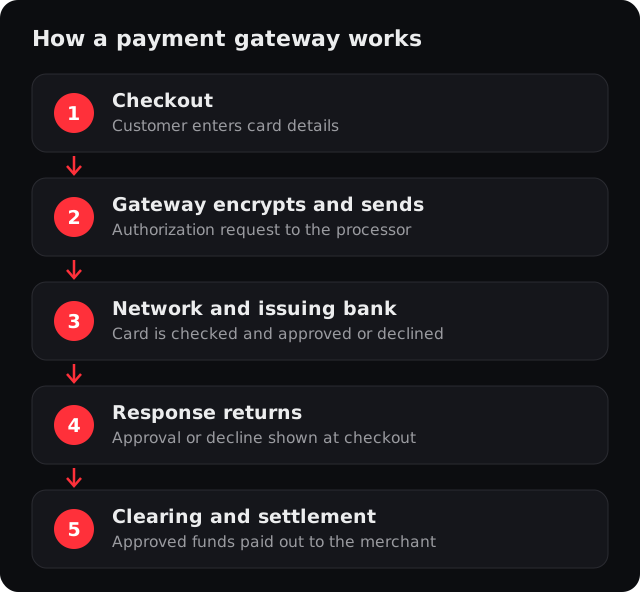
How does a payment gateway work? The transaction flow
A payment gateway works by encrypting card data at checkout, sending an authorization request to the processor and card network, relaying the issuer's approve or decline back to the store, and then passing the approved transaction on for clearing and settlement. Authorization happens in seconds; settlement follows over the next days.
- 1Checkout capture
The customer submits card details on the checkout page. The payment gateway immediately encrypts the data and can tokenize it, replacing the card number with a non-sensitive token.
- 2Authorization request
The gateway forwards the request to the payment processor, which routes it through the relevant card network (Visa, Mastercard, Amex, Discover) to the customer's issuing bank (the issuer).
- 3Approve or decline
The issuer checks funds, verifies the card, and can trigger 3-D Secure (3DS2) step-up authentication. It returns an approve or decline, which the gateway relays to the storefront in seconds.
- 4Capture and clearing
The approved transaction is captured and sent by the processor to the merchant's acquirer (acquiring bank) for clearing through the network.
- 5Settlement
The acquirer deposits the funds, minus fees, into the merchant's account over a period of business days. The gateway also applies fraud controls during this flow, including AVS, CVV checks, and real-time risk scoring, before an authorization is ever requested.
Payment gateway vs payment processor: what is the difference?
A payment gateway is the software that captures and secures card data at the point of checkout. A payment processor is the service that routes the authorization between the card networks and banks and moves the money. The gateway is the secure front door; the processor is the plumbing that settles funds.
| Payment processor | Payment gateway | |
|---|---|---|
| Core role | Routes authorization and moves the money | Captures and secures card data at checkout |
| Where it sits | Back end, between networks and banks | Front end, at the checkout page |
| Handles card data | Transmits it to networks and issuer | Encrypts and tokenizes it |
| Talks to the acquirer | Clears and settles through it | Passes the request toward it |
| Fraud tools | Network-level checks and settlement risk | AVS, CVV, 3-D Secure, risk scoring |
| Needed to accept cards online | Yes, alongside an acquirer | Yes |
What are examples of payment gateways?
Common payment gateway examples include Stripe, PayPal, Authorize.Net, Braintree, Square, and Checkout.com, plus Shopify Payments for Shopify merchants. Some are gateway-only, while others bundle the gateway, processor, and acquiring together. High-risk verticals often need a specialist gateway when these mainstream options decline or close the account.
| Gateway | Typical model | Notes |
|---|---|---|
| Stripe | Gateway plus processing bundled | Powers Shopify Payments; restricts many high-risk verticals |
| PayPal | Gateway, processor, and wallet | Widely accepted; can freeze or limit accounts |
| Authorize.Net | Gateway-focused | Pairs with a separate merchant account and acquirer |
| Braintree | Gateway plus processing (PayPal-owned) | Developer-focused API |
| Square | Gateway, processor, and hardware | Aimed at retail and small business |
| Shopify Payments | Built-in Stripe-powered gateway | Default on Shopify; limited for high-risk categories |
How do you choose a payment gateway?
Choose a payment gateway by matching it to your business risk profile, checking supported currencies and countries, confirming PCI DSS compliance and tokenization, reviewing pricing and settlement speed, and verifying it integrates with your platform. High-risk merchants should prioritize a gateway with acquirers that accept their vertical, plus built-in chargeback and fraud tooling.
Vertical acceptance
Confirm the underlying acquirer actually underwrites your category. This is the deciding factor for high-risk merchants, and where mainstream gateways fail.
Platform integration
Verify the gateway works with your stack, whether that is Shopify, WooCommerce, or a custom checkout, so you are not rebuilding your storefront.
Security and compliance
Require PCI DSS compliance, tokenization, encryption in transit and at rest, and 3-D Secure (3DS2) support.
Fraud, pricing and reliability
Look for AVS, CVV, real-time scoring, and chargeback prevention built in. Compare transaction fees, gateway fees, settlement speed, and confirm uptime and support responsiveness.
What does a payment gateway mean for subscription and Shopify merchants?
For subscription and Shopify merchants, the gateway is where approval is often lost: Shopify Payments and Stripe decline, freeze, or close accounts in verticals they do not want to support. A gateway that boards the merchant on established rails, with card vaulting plus fraud and chargeback tooling built in, keeps the store processing instead of shutting it down.
Merchants in categories such as nutraceuticals and supplements, health and wellness subscriptions, telehealth, crypto, and iGaming frequently find that mainstream gateways will not authorize their transactions, and Shopify Payments (which is Stripe-powered) inherits those same restrictions. When that happens, the merchant needs a gateway backed by a provider that underwrites the vertical on purpose rather than a generic one that blocks it.
SwissPay.ai is built for exactly this gap. SwissPay is a PayPal-managed payment facilitator, operated by MintAds Inc., that boards and underwrites US and Canadian merchants in-house on PayPal rails, so a merchant does not need their own PayPal account. Transactions are processed on PayPal, one of the most established payment networks on the internet, and SwissPay pairs the gateway with card and PayPal-wallet vaulting for subscriptions and rebills, a tokenized card vault within its PCI DSS Level 1 environment, real-time fraud scoring using address (AVS), device and risk signals, 3-D Secure 2 where required, and chargeback plus PayPal dispute handling with automated evidence submission. It connects to a store through a Shopify plugin, a WooCommerce plugin, hosted checkout, or a REST API, with USD settlement to the merchant's own bank account. If Shopify Payments or Stripe has declined or closed you, a gateway that underwrites your vertical deliberately is the usual next step.
Declined by Shopify Payments or Stripe, or just want an alternative gateway?
See how SwissPay approaches high-risk merchant accounts and a Shopify high-risk gateway, boarded and underwritten in-house on PayPal rails with fraud and chargeback tooling built in.
Start my applicationRelated
Frequently asked questions
What is a payment gateway in simple terms?
What is the difference between a payment gateway and a payment processor?
What are examples of payment gateways?
Does Shopify need a separate payment gateway?
Is a payment gateway secure?
Which payment gateway is best for high-risk businesses?
Apply for a merchant account
Tell us about your business. One application, boarded and underwritten in-house on PayPal rails, with card and PayPal-wallet processing built for subscriptions.
- Boarded and underwritten in-house, no separate PayPal account needed
- Card and PayPal-wallet vaulting for subscriptions, trials and rebills
- PCI DSS Level 1, 3-D Secure 2 where required, and chargeback and dispute handling built in