What Is a Chargeback? How They Work and How to Reduce Them
A chargeback is a forced reversal of a card payment that a cardholder disputes through their bank instead of asking the merchant for a refund. Here is how the lifecycle works, how it differs from a refund, and how to reduce disputes.
A chargeback is a forced reversal of a card payment that a cardholder disputes through their issuing bank instead of asking the merchant for a refund. The bank pulls the funds back from the merchant, investigates the claim under the card network's rules, and either upholds or reverses the dispute.
What is a chargeback?
A chargeback is a payment reversal initiated by a cardholder's issuing bank when the customer disputes a transaction. Unlike a refund, the merchant does not approve it. The issuer reclaims the funds, the card network arbitrates under its reason codes, and the merchant can lose both the sale and a fee.
Chargebacks exist as a consumer-protection mechanism written into the rules of the major card networks, Visa, Mastercard, American Express and Discover. When a cardholder reports fraud, an unrecognized charge, an item that never arrived, or goods that did not match the description, the issuer can reverse the payment on their behalf. The mechanism protects buyers, but for a merchant it means money already banked can be clawed back weeks after the sale, along with a chargeback fee and a hit to the account's dispute ratio. Card networks set a maximum chargeback ratio, and merchants who cross it risk higher costs or account termination.
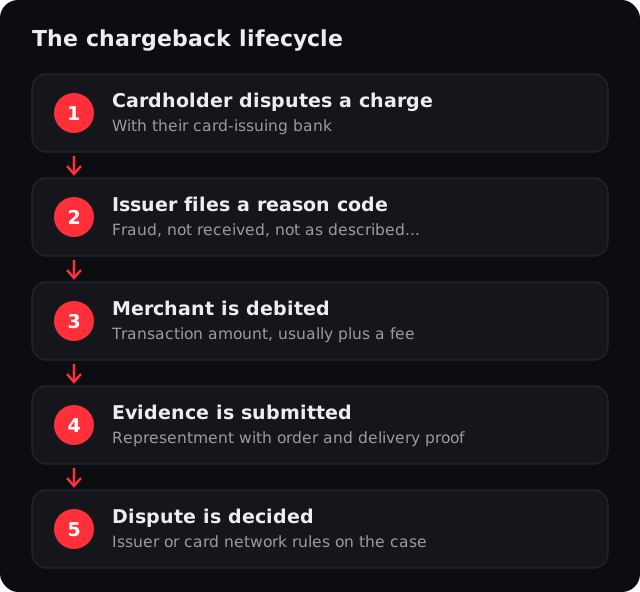
How do chargebacks work? The chargeback lifecycle
A chargeback moves through a defined lifecycle: the cardholder disputes a charge, the issuing bank files it under a reason code, the acquirer debits the merchant, the merchant can accept the loss or fight it with representment evidence, and the card network arbitrates if the two banks still disagree.
- 1Dispute filed
The cardholder contacts their issuing bank (the issuer) to dispute a transaction.
- 2Reason code assigned
The issuer classifies the dispute with a reason code (for example fraud, product not received, or not as described) and provisionally credits the cardholder.
- 3Funds pulled
The card network routes the dispute to the merchant's acquirer (acquiring bank), which debits the merchant's account for the disputed amount plus a chargeback fee.
- 4Merchant responds
The merchant either accepts the chargeback or fights it through representment, submitting compelling evidence such as proof of delivery, an AVS or CVV match, 3-D Secure authentication, or a signed authorization.
- 5Arbitration
If the issuer rejects the representment, the case can escalate to pre-arbitration and then network arbitration, where the card network makes a binding ruling and assigns the final liability. Time limits for each stage are set by the card networks, not the merchant.
Chargeback vs refund: what is the difference?
A refund is a voluntary return of funds the merchant issues directly to the customer, usually through the original payment method. A chargeback is an involuntary reversal forced by the cardholder's bank without the merchant's consent. Refunds are cheaper, faster and do not count against a merchant's chargeback ratio.
| Refund | Chargeback | |
|---|---|---|
| Who initiates it | The merchant | The cardholder, via the issuing bank |
| Merchant consent | Required | Not required |
| Funds path | Merchant returns funds to customer | Issuer reclaims funds from acquirer |
| Counts toward chargeback ratio | No | Yes |
| Typical speed | Days | Weeks to months |
| Merchant can contest | Not applicable | Yes, via representment |
| Effect on merchant account | Minimal | Can trigger monitoring or termination if ratio is high |
What are the most common reasons for chargebacks?
Chargebacks fall into a few recurring categories: true fraud from stolen card data, friendly fraud where a real cardholder disputes a legitimate purchase, products not received, items not as described, subscription and recurring-billing confusion, and simple non-recognition of an unclear billing descriptor on the statement.
| Reason category | What happens | Typical example |
|---|---|---|
| Criminal fraud | Card data used without the owner's consent | Stolen card number used online |
| Friendly fraud or first-party misuse | Real cardholder disputes a genuine purchase | I don't recognize this charge on a real order |
| Product not received | Goods or services never delivered | Package lost or never shipped |
| Not as described | Item differs from the listing | Wrong size, color or specification |
| Subscription confusion | Recurring charge the customer forgot or wanted cancelled | Free-trial roll-over billed monthly |
| Unclear descriptor | Statement name the buyer does not recognize | Legal entity name shown instead of brand |
How do you reduce chargebacks?
Reduce chargebacks by preventing disputes before they are filed: use a clear billing descriptor, offer fast and visible refunds, deploy fraud tools like AVS, CVV and 3-D Secure, send order and shipping confirmations, keep delivery evidence for representment, and respond to every recoverable dispute with strong evidence.
Clear billing descriptor
Make the statement name match the brand the customer bought from so charges are recognized. Non-recognition is a leading cause of avoidable disputes.
Fraud screening
Apply AVS (address verification), CVV checks, 3-D Secure (3DS2) authentication and real-time fraud scoring so criminal transactions never settle.
Easy refunds and support
A visible refund path and responsive support divert complaints away from the dispute channel, and cut not-received and subscription disputes.
Alerts and representment
Chargeback-alert networks give a short window to refund before a dispute is finalized, and strong representment evidence contests illegitimate chargebacks. Maintaining PCI DSS reduces the data-breach fraud that drives disputes.
What do high chargebacks mean for subscription and high-risk merchants?
For subscription and high-risk-adjacent merchants, a rising chargeback ratio is an existential threat: mainstream processors like Stripe and PayPal often freeze, hold or close accounts once disputes climb. A payments partner that underwrites these categories on purpose and adds chargeback tooling gives the account a better footing than one that only tolerates the category.
Merchants in categories such as nutraceuticals and supplements, health and wellness subscriptions and rebills, telehealth and GLP-1 prescription programs, crypto and iGaming tend to see higher dispute rates, and mainstream platforms often respond by declining or terminating those accounts rather than managing the risk. Crossing a card network's chargeback threshold can push a business into a monitoring program or off a processor entirely.
SwissPay.ai approaches this differently. SwissPay is a PayPal-managed payment facilitator operated by MintAds Inc.: it boards and underwrites US and Canadian merchants in-house on PayPal rails, so merchants do not need their own PayPal account. It is built for subscriptions, trials and rebills with card and PayPal-wallet vaulting, and it pairs the account with chargeback and PayPal dispute handling with automated evidence submission, 3-D Secure 2 where required, and real-time fraud scoring using address (AVS), device and risk signals. Payments are processed on PayPal, one of the most established payment networks on the internet, and SwissPay is a PCI DSS Level 1 Service Provider. If Stripe or Shopify Payments has declined or closed you over your category, an account underwritten for that category is the usual next step.
Worried a chargeback problem could cost you your account?
See how SwissPay approaches chargeback prevention and high-risk merchant accounts, or apply once to have your business reviewed for boarding on PayPal rails, with chargeback and dispute handling built in. Strong approvals on PayPal rails, with no guaranteed-approval promises.
Start my applicationRelated
Frequently asked questions
What is a chargeback in simple terms?
How long does a chargeback take?
Is a chargeback the same as a refund?
Can a merchant dispute a chargeback?
What is a good chargeback ratio?
How can high-risk merchants reduce chargebacks?
Apply for a merchant account
Tell us about your business. One application, boarded and underwritten in-house on PayPal rails, with card and PayPal-wallet processing built for subscriptions.
- Boarded and underwritten in-house, no separate PayPal account needed
- Card and PayPal-wallet vaulting for subscriptions, trials and rebills
- PCI DSS Level 1, 3-D Secure 2 where required, and chargeback and dispute handling built in