Crypto Payment Processing, Boarded on PayPal Rails
Crypto and digital-asset businesses are routinely declined by mainstream processors, so taking card payments is often the hard part. SwissPay boards these merchants on PayPal rails, so you take fiat card and PayPal-wallet payments with USD settlement to your own bank.
Crypto payment processing here means accepting card and PayPal-wallet payments for a crypto or digital-asset business, such as an on-ramp, exchange or wallet. SwissPay is a payment facilitator that boards and underwrites these merchants in-house on PayPal rails. It is a fiat payment path, not a blockchain settlement rail, with USD settlement to your bank.
What does crypto payment processing mean at SwissPay?
At SwissPay, crypto payment processing means accepting fiat card and PayPal-wallet payments for a cryptocurrency or digital-asset business. SwissPay is a fiat card and wallet payment path on PayPal rails, not a blockchain or crypto settlement rail. It does not custody or exchange digital assets. Your customers pay by card or PayPal wallet, and you settle in USD.
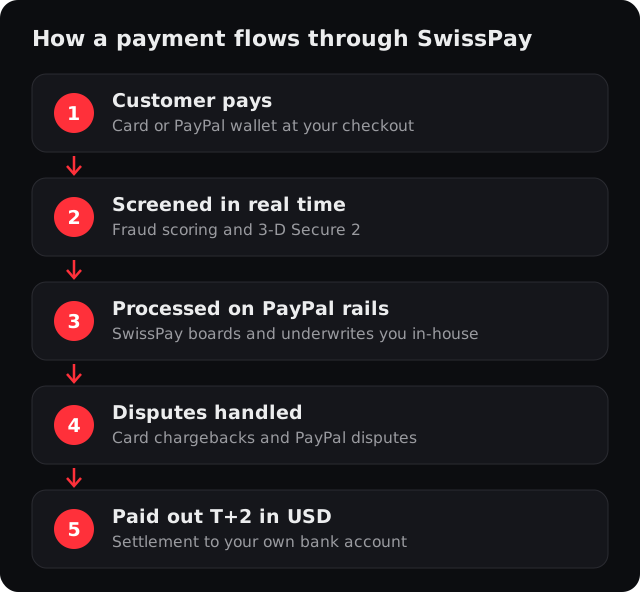
This is the point most crypto founders check first, so it is worth stating plainly. SwissPay does not move, hold, exchange or settle cryptocurrency. What it does is board your business as a merchant and let you accept fiat card payments and PayPal-wallet payments for whatever your platform sells, whether that is account funding, an on-ramp purchase, a subscription, a trading fee or a digital-asset product. The blockchain side stays entirely with you and your own infrastructure. SwissPay handles the fiat side on PayPal rails, with card and wallet vaulting for recurring charges, and settles to your bank in USD on a T+2 basis.
Why is crypto considered high risk?
Crypto is treated as high risk because of chargeback exposure, fraud patterns, regulatory scrutiny and the reputational caution most acquirers apply to digital assets. Card networks classify these merchant category codes tightly, so mainstream processors decline or close crypto accounts. A payment facilitator that underwrites the category, like SwissPay, reviews these businesses in-house instead.
The risk label has little to do with whether your business is legitimate. On-ramps, exchanges and wallets see elevated chargeback and fraud pressure, sit under active regulatory attention, and carry a merchant category code that most banks avoid by policy. Mainstream platforms manage that exposure by declining or shutting down the account. SwissPay boards and underwrites crypto merchants in-house on PayPal rails instead, with real-time fraud scoring and chargeback and PayPal dispute handling built into every account.
How does SwissPay control chargebacks and fraud for crypto?
Crypto accounts run with 3-D Secure 2 where required, real-time fraud scoring across AVS, device and risk signals, and a tokenized card vault inside a PCI DSS Level 1 environment. Chargeback and PayPal dispute handling includes automated evidence submission. These controls matter most in crypto, where fraud and chargeback pressure run high.
Tokenized card vault
Card and wallet data is tokenized in a vault within the PCI DSS Level 1 Service Provider environment, with encryption in transit and at rest.
3-D Secure 2
3-D Secure 2 applies where required, using frictionless authentication where possible and a challenge step when needed.
Real-time fraud scoring
Fraud scoring weighs AVS results, device signals and other risk indicators before a charge clears.
Automated dispute evidence
When a dispute or PayPal case is opened, chargeback and dispute handling with automated evidence submission responds on your behalf.
What compliance is your responsibility as a crypto merchant?
SwissPay provides the fiat payment path on PayPal rails and its own payment-side compliance, including PCI DSS Level 1. Your own crypto, money-transmitter and AML or KYC licensing remains your responsibility. SwissPay does not provide legal, financial or investment advice, and it does not accept unlicensed money services.
There is a clean line between the two sides. On the payments side, SwissPay operates as a PCI DSS Level 1 Service Provider with its FINTRAC (Canada) MSB registration in progress. On your side, any licensing your digital-asset business needs, such as money-transmitter registration, virtual-asset service-provider status, or your own AML and KYC program, stays with you. Crypto businesses need the licenses or registrations their activity requires, and SwissPay does not accept unlicensed money services.
What makes a crypto business easier to assess?
Across the industry, a crypto business that is easy to understand is easier to assess. A live website with clear terms, a plain description of what customers buy, and licensing that matches the activity all help. SwissPay reviews and underwrites each application in-house and does not publish its underwriting criteria.
Licensing is the first thing to get right, because SwissPay does not accept unlicensed money services. Make sure the descriptor customers see on their statement also matches your brand, since unrecognized charges are a common source of disputes in any category.
If you run an on-ramp, exchange or wallet, explain how a fiat card or PayPal-wallet payment maps to what the customer receives. A clear payment flow is easier for any risk team to assess, whichever processor you apply to.
How do I get started with SwissPay crypto processing?
Submit one application with your business details, digital-asset model and website. SwissPay reviews and underwrites you in-house, with no PayPal account required. If approved, you go live on a rich REST API, hosted checkout, or the Shopify and WooCommerce plugins. Start at the application form or email support@swisspay.ai.
- 1Complete the application
Provide your business name, contact, website and digital-asset model.
- 2We review and underwrite you
SwissPay reviews and underwrites your business in-house.
- 3Go live on your integration
Launch on a rich REST API, hosted checkout, or the Shopify and WooCommerce plugins.
- 4Accept payments and settle
Accept card and PayPal-wallet payments, with card and wallet vaulting for subscriptions and rebills, and settle in USD.
Building an on-ramp, exchange or wallet?
Apply once and SwissPay will review your crypto business in-house, on PayPal rails.
Apply for a merchant accountRelated
Frequently asked questions
What is crypto payment processing at SwissPay?
Does SwissPay settle payments in cryptocurrency?
Do I need my own PayPal account to accept crypto payments?
Is my crypto or AML licensing handled by SwissPay?
How does SwissPay handle chargebacks and fraud on crypto transactions?
Can I apply if another processor declined my crypto business?
Apply for a merchant account
Tell us about your business. One application, boarded and underwritten in-house on PayPal rails, with card and PayPal-wallet processing built for subscriptions.
- Boarded and underwritten in-house, no separate PayPal account needed
- Card and PayPal-wallet vaulting for subscriptions, trials and rebills
- PCI DSS Level 1, 3-D Secure 2 where required, and chargeback and dispute handling built in