What Payment Gateways Does Shopify Support?
Shopify supports Shopify Payments plus a wide range of third-party payment providers. Here is how Shopify gateways work, how to choose one, and what high-risk shops should use.
Shopify supports two kinds of payment gateway: Shopify Payments, its built-in processor, and a wide range of third-party payment providers a merchant can connect instead of, or alongside, it. The exact list of supported providers varies by country and by store, so the real choice is which gateway fits your business.
What payment gateways does Shopify support?
Shopify supports its own built-in gateway, Shopify Payments, plus many third-party payment providers that merchants connect from their payment settings. The specific providers available depend on the store's country, currency and eligibility. When a store uses a third-party provider instead of Shopify Payments, Shopify may apply a separate transaction fee.
At a high level there are two paths a Shopify store can take to accept card payments. The first is Shopify Payments, the processor Shopify builds into the platform, which is powered by Stripe. The second is a third-party payment provider, an external gateway the merchant connects to route card payments through a different processor and acquirer. Shopify publishes the list of supported third-party providers, and that list changes over time and by region. The right question for most merchants is not only what Shopify supports, but which option will actually approve and serve their type of business.
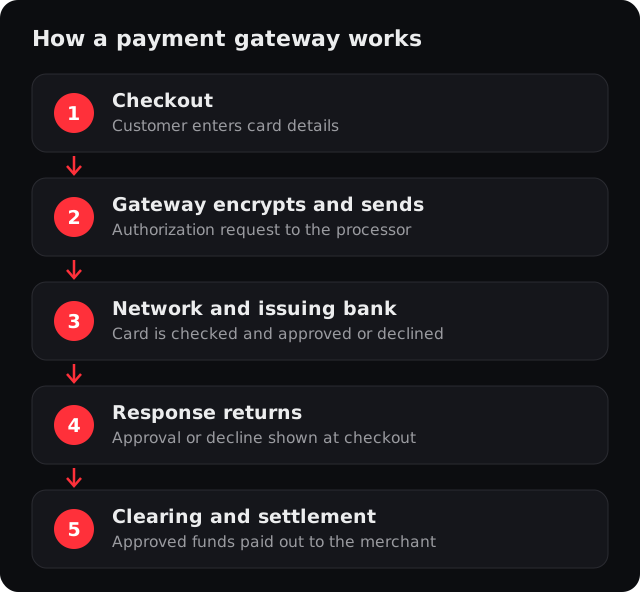
Shopify Payments vs third-party payment providers
Shopify Payments is the native gateway built into Shopify, with no third-party transaction fee and the tightest checkout integration. A third-party payment provider is an external gateway you connect yourself; it can serve businesses, countries and currencies Shopify Payments does not, but Shopify may charge a per-transaction fee for using it.
| Shopify Payments | Third-party provider | |
|---|---|---|
| Integration | Native, built into the Shopify dashboard | External gateway you connect in payment settings |
| Powered by | Stripe | Usually the provider's own acquirer; for SwissPay, PayPal's managed payment-facilitator path |
| Eligibility | Restricts the regions and higher-risk categories Stripe restricts | Can support your country, currency, or vertical directly |
| Shopify transaction fee | None | Shopify may apply a per-transaction fee |
| Redundancy | Single native processor | Can act as a second processor for failover |
| High-risk verticals | Largely restricted | Supported by specialist providers |
How many payment gateways does Shopify support, and which ones?
Shopify supports Shopify Payments plus a large and changing list of third-party payment providers, and the providers available depend on your country. Because the list is region-specific and updated regularly, the accurate answer is to check Shopify's own supported-provider documentation for your market rather than rely on a fixed count.
The number of supported third-party providers is not a single global figure. Availability is set per country, and Shopify adds and removes providers over time, so any specific count or named list goes stale quickly. What stays constant is the structure: one native option, Shopify Payments, and a category of connectable third-party providers. When you evaluate the third-party list, the deciding factors are whether a provider supports your country and currency, whether it accepts your vertical, and what it will cost, including any Shopify third-party transaction fee.
The Shopify third-party transaction fee, explained
When a Shopify store uses a third-party payment provider instead of Shopify Payments, Shopify may charge a separate per-transaction fee on top of the provider's own processing rate. The fee depends on the store's Shopify plan and market, so merchants should confirm the current terms for their plan.
This fee is a common surprise, so it is worth understanding before choosing a gateway. It is a Shopify platform charge, not a charge from the third-party provider, and it exists because the store is not using Shopify Payments. The amount is tied to the Shopify plan the merchant is on, and Shopify sets and updates it. For a merchant who cannot use Shopify Payments at all, the fee is simply the cost of staying open, and it is usually far smaller than the revenue lost from a checkout that cannot process cards.
How to choose the best payment gateway for Shopify
Choose a Shopify payment gateway by matching it to your business: confirm it supports your country and currency, check that it accepts your product category, compare its processing rate against any Shopify third-party fee, and look for fraud tooling, chargeback support, and reliable settlement before you commit.
Eligibility first
Confirm the gateway supports your country, your currency, and your product category. A lower rate is irrelevant if the provider will not approve your business.
Total cost
Compare the provider's processing rate plus any Shopify third-party transaction fee against Shopify Payments, not the headline rate alone.
Risk fit
If you sell a restricted or higher-risk product, look for a provider that underwrites your category on purpose rather than one that will close the account later.
Fraud and dispute tooling
Look for AVS, CVV, 3-D Secure (3DS2), and chargeback support built in, since disputes are what get accounts frozen.
Reliability and settlement
Check settlement timing, uptime, and whether you can run a second gateway for failover.
Support
A responsive team matters most when funds are held or a dispute is filed.
What high-risk Shopify merchants should use
High-risk Shopify merchants often cannot use Shopify Payments, so they need a third-party payment provider that underwrites their category on purpose. A specialist gateway connects to Shopify, processes card payments through an acquirer that accepts the vertical, and keeps checkout live where the mainstream options decline the store.
Merchants in categories such as nutraceuticals and supplements, health and wellness subscriptions, telehealth and GLP-1, cryptocurrency and iGaming are among the hardest to place, because Shopify Payments, running on Stripe, restricts many of these verticals and will often decline, ban or freeze the store rather than manage the risk. For these merchants the supported-gateway question has a narrower answer: they need a third-party provider built for their category.
SwissPay.ai is that option. SwissPay is a PayPal-managed payment facilitator operated by MintAds Inc., and it connects to Shopify through the SwissPay Shopify plugin for stores that Shopify Payments will not serve, whether the store was declined, banned or frozen, or simply wants an alternative processor. SwissPay boards and underwrites merchants in-house on PayPal rails, so merchants do not need their own PayPal account, and card payments are processed on PayPal, one of the most established payment networks on the internet. Approval always depends on underwriting; there is no guaranteed approval, but SwissPay is built for supported categories the mainstream gateways turn away, with strong approvals on PayPal rails.
Cannot use Shopify Payments for your store?
See how SwissPay works as a high-risk payment gateway for Shopify, read more on using a third-party payment provider on Shopify, or apply once and SwissPay's team will review your business. Approval depends on your business.
Apply for a merchant accountRelated
Frequently asked questions
What payment gateways does Shopify support?
Is Shopify Payments the same as a payment gateway?
Can I use a third-party payment provider on Shopify?
Does Shopify charge a fee for using a third-party gateway?
What is the best payment gateway for Shopify?
Which payment gateway should high-risk Shopify stores use?
Apply for a merchant account
Tell us about your business. One application, boarded and underwritten in-house on PayPal rails, with card and PayPal-wallet processing built for subscriptions.
- Boarded and underwritten in-house, no separate PayPal account needed
- Card and PayPal-wallet vaulting for subscriptions, trials and rebills
- PCI DSS Level 1, 3-D Secure 2 where required, and chargeback and dispute handling built in