What Is a High-Risk Merchant Account? A Clear Guide
A high-risk merchant account is a payment processing account for businesses that banks and card networks consider risky. Here is what makes a business high-risk, how it differs from a standard account, and how to get one.
A high-risk merchant account is a payment processing account for businesses that banks and card networks consider more likely to generate chargebacks, fraud or regulatory trouble. It works like a standard account but is underwritten by a specialist acquirer, often with higher fees, a rolling reserve, and closer monitoring in exchange for stable card acceptance.
What is a high-risk merchant account?
A high-risk merchant account is a card-processing account underwritten specifically for businesses that acquiring banks classify as high-risk. It lets the business accept credit and debit cards, but through an acquirer that accepts a higher chance of chargebacks, fraud or compliance exposure, usually in exchange for higher fees and a reserve.
Every business that takes cards needs a merchant account, which is the account through which card payments are authorized and settled. The account carries a merchant category code, or MCC, that tells the card networks what the business sells. During underwriting, the provider reviews the business model, its MCC, its expected volume and its chargeback history and decides how much risk it represents. A high-risk merchant account is simply the version of that account issued when the risk assessment lands on the higher end. Mainstream aggregators such as Stripe tend to decline or later close these businesses, so a specialist provider fills the gap by boarding and underwriting the category on purpose.
What makes a business high-risk?
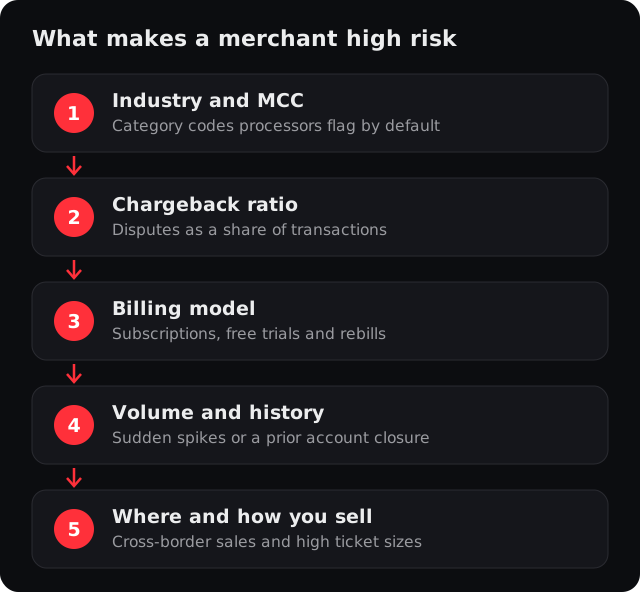
A business is labeled high-risk when its industry, model or track record raises the odds of chargebacks, fraud or regulatory issues for the acquirer. Common triggers include a high-risk MCC, recurring or subscription billing, large ticket sizes, selling internationally, a poor chargeback ratio, a new or thin processing history, and prior account closures.
Industry and MCC
Some merchant category codes are treated as high-risk by default, including nutraceuticals and supplements, subscription and continuity billing, telehealth, iGaming, cryptocurrency and skincare or beauty.
Chargeback ratio and billing model
A history of disputes above a card network's threshold flags the account regardless of industry. Recurring, subscription, free-trial and continuity billing generate more disputes and draw closer scrutiny.
Processing profile
High average ticket values, high monthly volume, or cross-border and multi-currency sales all raise perceived risk.
Maturity and regulation
A new business with no processing history, an owner with bad credit or a prior termination, or products with legal, age or licensing restrictions all carry risk the acquirer must manage.
High-risk vs standard merchant account: what is the difference?
A standard merchant account serves low-risk businesses through mainstream acquirers or aggregators, with lower fees and little scrutiny. A high-risk merchant account serves flagged industries or profiles through specialist acquirers, with higher fees, a rolling reserve, tighter monitoring, and underwriting built to keep the account open.
| Standard merchant account | High-risk merchant account | |
|---|---|---|
| Typical business | Low-risk retail and services | Flagged industry or risk profile |
| Provider | Mainstream acquirer or aggregator | Specialist high-risk acquirer |
| Underwriting | Fast, light-touch | Detailed review of model, MCC, history |
| Rolling reserve | Rarely required | Often required |
| Chargeback tolerance | Low; account can close quickly | Managed with prevention tooling |
| Account stability for flagged verticals | Poor; freezes and closures common | Built to keep the account open |
| Volume and country flexibility | Limited on aggregators | Multi-currency and cross-border support |
Which businesses are considered high-risk?
High-risk status usually tracks the industry. Card networks and providers treat certain verticals as high-risk because of higher chargebacks, fraud, legal restrictions or reputational exposure. If a business operates in one of these categories, it will often need a high-risk merchant account even with a clean record.
| Vertical | Why it is high-risk | Typical processing concern |
|---|---|---|
| Nutraceuticals and supplements | Free-trial and continuity billing, health claims | Subscription chargebacks, refund disputes |
| Subscriptions and free trials | Recurring billing, cancellation disputes | Rebill chargebacks, refund handling |
| Telehealth and GLP-1 | Prescription rules, licensing, care documentation | Underwriting scrutiny, compliance evidence |
| iGaming and betting | Licensing rules, fraud, regulatory patchwork | Jurisdiction and MCC restrictions |
| Cryptocurrency and digital assets | Volatility, fraud, evolving regulation | Limited provider appetite |
| Skincare and beauty | Subscription and trial billing, high refund rates | Rebill chargebacks, refund disputes |
| Health testing and wellness | Recurring billing, delivery timing | Subscription chargebacks |
How much does a high-risk merchant account cost, and what should you expect?
Expect a high-risk merchant account to cost more than a standard one and to come with a reserve. Providers commonly charge higher discount rates and transaction fees and may hold a rolling reserve, a percentage of sales kept back for a set period to cover potential chargebacks, plus setup or monthly fees that vary by provider and risk profile.
Rates and reserve
High-risk discount rates and per-transaction fees typically run above standard rates. Many accounts hold a rolling reserve, a portion of sales returned to the merchant over time, not lost.
Underwriting requirements
Expect to provide business documents, processing statements, and details on your model and refund policy.
Onboarding and monitoring
Specialist underwriting can take longer than an aggregator sign-up. The account is watched against the card network chargeback ratio, so prevention tooling protects your pricing and standing.
No guarantees
No legitimate provider can promise approval or a guaranteed rate before underwriting. Terms are set case by case.
Do I need a high-risk merchant account, and how do I get one?
You likely need a high-risk merchant account if a mainstream processor declined, froze or closed you, if your industry sits on a high-risk MCC list, or if your chargeback ratio or billing model keeps triggering problems. To get one, apply with a specialist provider that underwrites your category deliberately.
If Stripe or another mainstream processor has already declined your application, held your funds, or closed your account, that is the clearest signal you need a specialist. Businesses with recurring billing, subscription or trial models, and those recovering from a prior termination usually cannot rely on aggregator processing to stay live.
SwissPay.ai is built for exactly this situation. SwissPay is a PayPal-managed payment facilitator, operated by MintAds Inc., that boards and underwrites merchants in-house on PayPal rails, so you do not need your own PayPal account. It serves supported higher-risk verticals such as nutraceuticals and supplements, subscriptions and trials, telehealth and GLP-1 via a licensed pharmacy, cryptocurrency, iGaming, and skincare and beauty. SwissPay reviews each application in-house, and boarded merchants get card and wallet vaulting for subscriptions and rebills, real-time fraud scoring using address (AVS), device and risk signals, and 3-D Secure 2 where required. As a PCI DSS Level 1 Service Provider with chargeback and PayPal dispute handling, automated evidence submission and T+2 settlement to your own bank, SwissPay is built for supported businesses in these categories.
Not sure whether you need one, or been declined already?
See how SwissPay approaches high-risk merchant accounts and its subscription-ready processing on PayPal rails for supported verticals. No guaranteed-approval promises; terms are set during underwriting.
Start my applicationRelated
Frequently asked questions
What is a high-risk merchant account in simple terms?
What makes a business high-risk?
How is a high-risk merchant account different from a standard one?
Do I need a high-risk merchant account?
Why is my business considered high-risk if I have done nothing wrong?
How do I get a high-risk merchant account?
Apply for a merchant account
Tell us about your business. One application, boarded and underwritten in-house on PayPal rails, with card and PayPal-wallet processing built for subscriptions.
- Boarded and underwritten in-house, no separate PayPal account needed
- Card and PayPal-wallet vaulting for subscriptions, trials and rebills
- PCI DSS Level 1, 3-D Secure 2 where required, and chargeback and dispute handling built in