High-Risk MCC Codes: What They Are and Why They Matter
High-risk MCC codes are merchant category codes card networks and acquirers flag for fraud, chargeback or legal risk. Here is what an MCC is, how it drives risk classification, and what to do if you are in one.
A high-risk MCC code is a merchant category code that card networks and acquirers treat as prone to fraud, chargebacks, refunds or legal exposure. The four-digit code classifies what a business sells, and certain categories carry a high-risk label that raises pricing, reserves and the chance of account decline.
What is an MCC code?
A merchant category code, or MCC, is a four-digit number that card networks assign to a business to describe the type of goods or services it sells. Payment processors, acquirers and issuers use the MCC to price transactions, apply rules, calculate rewards and interchange, and flag categories that carry extra risk.
MCCs are standardized under ISO 18245, the international standard for retail financial services merchant category codes, and each card network, Visa, Mastercard, American Express and Discover, maintains its own list mapped to that standard. When a merchant opens a payment account, the acquirer assigns an MCC during underwriting based on the business's actual products and website. That single code then follows every transaction through the network, telling the issuing bank what kind of purchase it is. The same code drives cardholder rewards, interchange rates, tax reporting, and whether the account is treated as standard or high-risk.
How do MCCs affect risk classification?
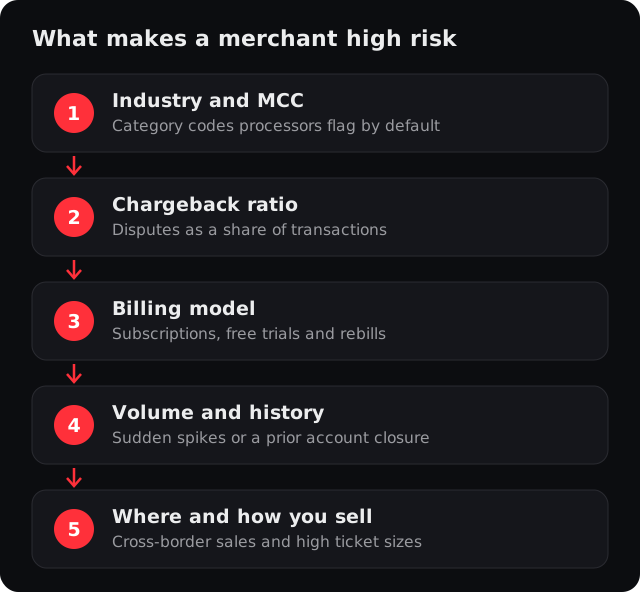
MCCs drive risk classification because the code tells acquirers and card networks, before a single sale, which category a merchant falls into. Categories with historically high chargeback rates, fraud exposure, refund volume, regulatory scrutiny or recurring-billing complaints are labeled high-risk, which changes underwriting, pricing, reserves and the odds of approval.
High chargeback and dispute rates
Categories that can breach a card network's monitoring threshold, such as the Visa Dispute Monitoring Program or the Mastercard Excessive Chargeback Program, are treated as high-risk.
Fraud exposure
Common in card-not-present, digital-goods and cross-border categories, where stolen card data and remote transactions raise the loss rate.
Regulatory or legal risk
Categories such as tobacco, firearms or adult content, where legality varies by jurisdiction, carry compliance risk the acquirer must underwrite.
Billing and delivery timing
Recurring billing and free-trial models generate cancellation and did-not-authorize disputes, and future-delivery categories like travel add their own dispute risk. A high-risk MCC does not mean a business is doing anything wrong; the acquirer simply prices in more risk.
What are examples of high-risk MCCs?
High-risk MCCs cluster around a handful of categories: nutraceuticals and supplements, tobacco and vape, adult content, gambling and betting, forex and trading, cryptocurrency, travel and ticketing, dating, and continuity or subscription billing. The table below lists widely-published example categories for illustration; the exact code assigned depends on how the acquirer classifies the specific business during underwriting.
| Category described | Why it is often high-risk |
|---|---|
| Drugs, drug proprietaries and druggist sundries | Regulatory scrutiny; where nutra products are often classified |
| Drug stores and pharmacies | Regulated products; age and legality checks |
| Cigar stores and stands (tobacco) | Age-restricted, regulated category |
| Package stores, beer, wine and liquor | Age-restricted, regulated category |
| Direct marketing, inbound telemarketing | Card-not-present, high refund and dispute rates |
| Direct marketing, continuity and subscription | Recurring-billing cancellation disputes |
| Betting, casino gaming and lottery | Gambling, legality varies by jurisdiction |
| Dating and escort services | Reputational and dispute risk |
| Digital currency, forex and money orders | Crypto and forex exposure, fraud and volatility |
| Travel agencies and tour operators | Future delivery and cancellation disputes |
How do you find your MCC?
You can find your MCC on a merchant account statement, in your payment processor or gateway dashboard, or by asking your acquirer directly. Some card-network lookup tools also let you check the code tied to a business. The MCC is set by the acquirer during underwriting, not chosen freely by the merchant.
- 1Read your merchant statement
Many acquirers print the assigned MCC on the monthly processing statement or in the account portal.
- 2Check your processor or gateway dashboard
Payment platforms often show the category code in the account or business-profile settings.
- 3Ask your acquirer or payment provider
The underwriting team that opened the account can confirm the exact MCC on file.
- 4Use a card-network lookup
Visa and Mastercard publish MCC references; match your business description to the listed category. If the assigned MCC does not match what the business sells, correct it with the acquirer, because deliberately miscoding a business is a serious compliance violation that can shut an account down.
What should you do if you are in a high-risk MCC?
If your business falls under a high-risk MCC, work with a payment provider that underwrites your category on purpose instead of one that declines or freezes it. A specialist high-risk merchant account is underwritten for that category and pairs the account with fraud and chargeback tooling.
Mainstream platforms such as Stripe and Shopify Payments, which is powered by Stripe, restrict or prohibit many high-risk MCCs outright, so merchants in restricted categories are often declined at signup or shut down later when the category is discovered. Being in a high-risk MCC is not a dead end; it means the account belongs with a provider that underwrites the category.
SwissPay.ai is built for exactly this. SwissPay is a PayPal-managed payment facilitator operated by MintAds Inc. that boards and underwrites merchants in-house on PayPal rails, so merchants do not need their own PayPal account. It layers in real-time fraud scoring using address (AVS), device and risk signals, 3-D Secure 2 (3DS2) where required, and chargeback and PayPal dispute handling with automated evidence submission. It is a PCI DSS Level 1 Service Provider. For Shopify store owners who cannot use Shopify Payments for their category, SwissPay offers a Shopify plugin, a WooCommerce plugin, a REST API and hosted checkout.
SwissPay's accepted verticals are its supported set, not every high-risk MCC in the table above. Supported categories include nutraceuticals and dietary supplements, health and wellness subscriptions, telemedicine and telehealth, prescription via licensed telehealth pharmacy, cryptocurrency and digital assets, iGaming, and skincare, cosmetics and beauty on subscription. Being in one of the supported high-risk-adjacent categories is not a dead end; it means the account belongs with a provider that expects the category and underwrites it deliberately.
In a supported high-risk-adjacent category and getting declined?
See how SwissPay approaches high-risk merchant accounts for supported verticals like nutraceuticals and supplements, subscriptions and rebills, telehealth, crypto and iGaming, boarded and underwritten in-house on PayPal rails.
Start my applicationRelated
Frequently asked questions
What is an MCC code?
What makes an MCC high-risk?
Which business categories usually have high-risk MCCs?
How do I find my MCC code?
Can I change my MCC code?
Can I process high-risk MCC payments on Shopify?
Apply for a merchant account
Tell us about your business. One application, boarded and underwritten in-house on PayPal rails, with card and PayPal-wallet processing built for subscriptions.
- Boarded and underwritten in-house, no separate PayPal account needed
- Card and PayPal-wallet vaulting for subscriptions, trials and rebills
- PCI DSS Level 1, 3-D Secure 2 where required, and chargeback and dispute handling built in