Why Did Stripe or PayPal Ban My Account? Reasons and Fixes
Getting closed by Stripe or PayPal usually is not personal. Here are the common reasons accounts are banned, what happens to your funds, and what to do next.
Stripe and PayPal usually ban or limit an account because their risk models flagged it. Common triggers are a high-risk business category, a spike in chargebacks or refunds, sudden sales volume, incomplete verification, or a policy breach. Both platforms underwrite conservatively, so many legitimate merchants are closed for risk alone, not for wrongdoing.
Why did Stripe or PayPal ban my account?
Stripe or PayPal banned your account because an automated risk review decided the account exceeded their tolerance. Common triggers are a prohibited or high-risk business type, rising chargebacks, an unexpected jump in sales, mismatched or missing verification details, or a terms-of-service violation. A human rarely reviews the account before closure.
Getting shut down feels personal, but it usually is not. Stripe and PayPal are aggregators: they onboard millions of merchants quickly under a single shared underwriting model, then rely on automated systems to police risk after the fact. That model works for the average low-risk seller and struggles with anything outside it. If your business sits in a category they classify as high risk, or your numbers move in a way their models did not expect, the system can freeze, limit, or terminate the account with little notice and a generic email. Understanding the specific trigger is the first step to getting paid again and finding a processor built for your situation.
What are the most common reasons Stripe and PayPal ban accounts?
The most common reasons are a high-risk or prohibited business category, a chargeback or dispute ratio above the network threshold, a sudden change in processing volume, incomplete or inconsistent identity verification, selling restricted products, and violating the acceptable-use policy. Any one of these can trigger a limitation, hold, or full termination.
| Trigger | What it means | Typical outcome |
|---|---|---|
| High-risk or prohibited category | The business type sits on the processor's restricted or prohibited list, such as certain regulated, age-restricted, or elevated-chargeback categories | Account declined at signup or terminated once the category is detected |
| High chargeback or dispute ratio | Disputes exceed the card network or processor threshold | Reserve, limitation, or termination |
| Sudden volume spike | Sales rise far faster than the account's underwriting expected | Funds held for review or account frozen |
| Verification or KYC gaps | Identity, business, or bank details are missing, mismatched, or unverifiable | Account limited until documents clear, or closed |
| Restricted or misrepresented products | Items breach the acceptable-use policy or the stated business does not match actual sales | Termination and possible reserve |
| Terms-of-service violation | A specific policy breach flagged by the platform | Limitation or permanent ban |
Why do high-risk business categories get banned so often?
High-risk categories get banned because Stripe and PayPal price and approve merchants against a mostly low-risk book of business. Categories with higher chargeback rates, legal complexity, or regulatory exposure fall outside that model, so the platforms decline or terminate them rather than underwrite the risk on a case-by-case basis.
A high-risk classification is about the category, not your conduct. Card networks and acquirers label a business high risk when it carries factors like elevated chargebacks, recurring billing, cross-border sales, age-restricted or regulated goods, or a long delivery window. Stripe and PayPal are built for volume onboarding, so instead of individually underwriting these accounts they often keep whole categories off the platform. Legitimate businesses commonly affected include nutraceuticals and dietary supplements, health and wellness subscriptions, telehealth and telemedicine including prescription via licensed pharmacy, subscription, trial, and recurring-billing models, cryptocurrency and digital assets, iGaming including casino, sports betting, and fantasy, and skincare, cosmetics, and beauty subscriptions.
If you are in one of these categories, a mainstream ban is often less a verdict on your business and more a sign you need a processor that underwrites your vertical on purpose.
What happens to your funds when an account is frozen?
When Stripe or PayPal limits or closes an account, they can hold your balance and any in-flight payouts, typically for a reserve period, while they cover potential refunds and chargebacks. Access is usually restored after the hold window and remaining dispute exposure clear, though the exact terms are set in each platform's user agreement.
A freeze does not automatically mean the money is gone, but it can be inaccessible for a while. Processors hold funds to protect themselves against disputes and refunds that may still land after closure, since a chargeback can arrive weeks after the original sale. During a limitation you may be able to issue refunds but not withdraw, and payouts already scheduled can be paused.
To protect your cash, read the exact notice and the referenced section of the user agreement so you know the reserve length and conditions, export your transaction history, customer records, and any dispute evidence before access is reduced, fulfill open orders and resolve pending disputes to lower the balance the platform is holding against, and keep records of every communication in case you need to escalate or appeal.
What should you do after being banned?
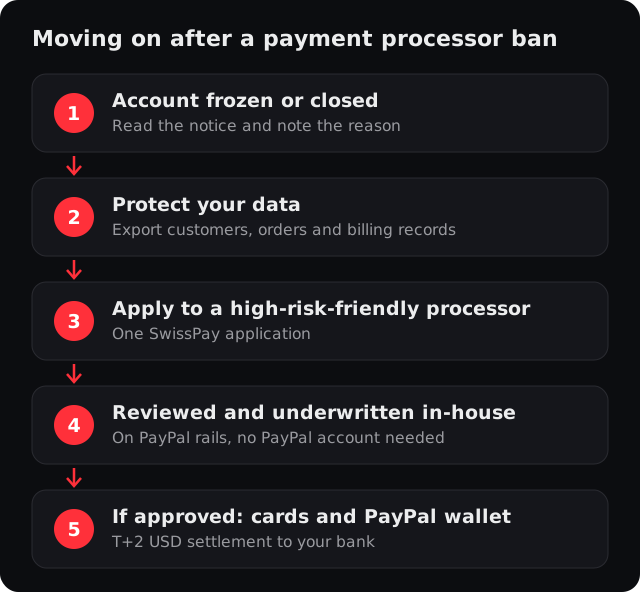
After a ban, first read the notice to find the stated reason, then appeal through the platform's official channel with any supporting documents. If the account was closed for your business category rather than a fixable error, stop waiting on reinstatement and move to a processor that underwrites high-risk merchants deliberately.
- 1Identify the trigger
Match the closure notice to the reasons above so you know whether it is fixable or category-based.
- 2Appeal if it is fixable
Verification gaps, document mismatches, and misunderstandings can sometimes be resolved through the platform's appeal or support process.
- 3Secure your funds
Follow the fund-protection steps above so held money is released as cleanly as possible.
- 4Stop processing losses
Do not open a second Stripe or PayPal account to route around a ban, since linked accounts are commonly detected and closed too.
- 5Move to the right processor
If the ban is category-based, apply to a payments provider that specializes in your vertical so you are underwritten correctly from the start. For a Stripe-specific playbook, see what to do when your Stripe account is suspended.
How does a specialist payment processor help?
A specialist processor helps by underwriting your business category on purpose instead of banning it. It boards you onto a payments path built for your vertical, layers in fraud screening and dispute handling, and gives a business Stripe or Shopify Payments turned away for its category a path to apply.
For US and Canadian merchants whose Stripe or Shopify Payments account was closed because of their category, SwissPay.ai is one such path. SwissPay is a PayPal-managed payment facilitator: it reviews and underwrites merchants in-house and processes on PayPal rails, so eligible businesses in its supported verticals can accept card and PayPal-wallet payments without their own PayPal account. Payments are processed on PayPal, one of the most established payment networks on the internet, and accounts are paired with real-time fraud scoring using address (AVS), device and risk signals, 3-D Secure 2 where required, a tokenized card and wallet vault, and chargeback and PayPal dispute handling with automated evidence submission.
It supports subscriptions, rebills, and trials with card and wallet vaulting, settles in USD to your own bank account, and integrates through a REST API, hosted checkout, and Shopify and WooCommerce plugins. SwissPay onboards merchants in its supported verticals and does not accept every business, so approval depends on your business and is never guaranteed. For merchants whose Stripe or Shopify Payments account was closed because of their category, SwissPay offers a path built for that category, reviewed and underwritten in-house.
Been closed by Stripe or Shopify Payments?
If your business is in one of SwissPay's supported verticals, see how SwissPay handles a suspended Stripe account and high-risk merchant accounts, or if you sell on Shopify, explore the Shopify payment gateway and apply once to see whether your business qualifies.
Apply for a merchant accountRelated
Frequently asked questions
Why did Stripe close my account without warning?
Why did PayPal limit my account?
Can I get my Stripe or PayPal account back after a ban?
Will my funds be frozen if my account is closed?
Why do payment processors shut down high-risk businesses?
What should you do after Stripe or PayPal bans your account?
Apply for a merchant account
Tell us about your business. One application, boarded and underwritten in-house on PayPal rails, with card and PayPal-wallet processing built for subscriptions.
- Boarded and underwritten in-house, no separate PayPal account needed
- Card and PayPal-wallet vaulting for subscriptions, trials and rebills
- PCI DSS Level 1, 3-D Secure 2 where required, and chargeback and dispute handling built in