High-Risk vs Low-Risk Merchant Account: The Difference
A high-risk merchant account carries higher fees, reserves and stricter underwriting; a low-risk account serves stable businesses at lower cost. Here is how they compare, why the label is assigned, and how to choose.
A high-risk merchant account is a payment-processing account for businesses that banks and card networks view as risky, so it carries higher fees, rolling reserves and stricter underwriting. A low-risk account serves stable, low-dispute businesses at lower cost. The classification is set by the acquiring bank, based on your industry, chargeback history and processing profile.
What is the difference between a high-risk and low-risk merchant account?
The difference is how the acquiring bank prices and controls the risk of processing your payments. A high-risk merchant account carries higher fees, rolling reserves, tighter chargeback limits and longer underwriting because the bank expects more disputes or liability. A low-risk merchant account has lower fees, no reserve and fast approval because the risk is minimal.
Both are merchant accounts: the account that lets a business accept card payments through an acquiring bank and the card networks, Visa, Mastercard, American Express and Discover. What separates them is the risk profile the acquirer assigns. A low-risk merchant, such as a typical retail store or a subscription app with few disputes, is cheap and quick to board because the acquirer expects stable volume and low chargebacks. A high-risk merchant is priced for exposure: the acquirer builds in a higher discount rate, a chargeback fee, and often a rolling reserve that holds back a percentage of sales to cover future disputes. The label is not a judgment of the business owner, it is a pricing and underwriting decision made by the bank that carries the liability.
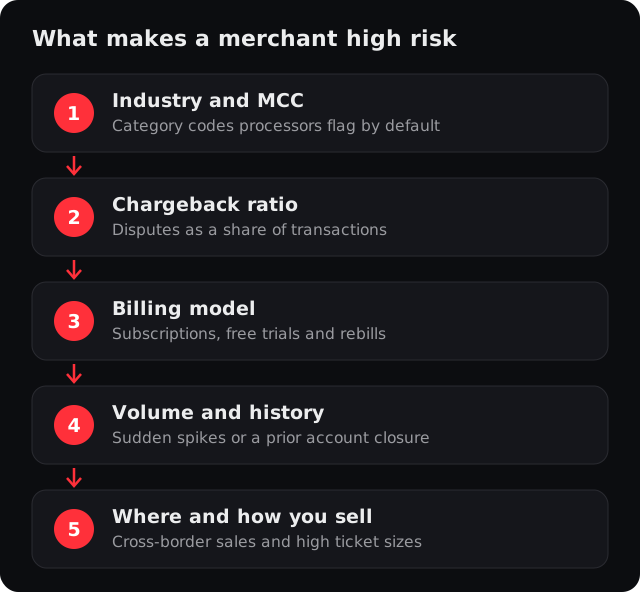
What makes a merchant high risk?
A merchant is classified high risk when the acquiring bank expects a greater chance of chargebacks, fraud, or financial liability. The main triggers are the industry (its MCC code), a history of high chargebacks, recurring or free-trial billing, cross-border sales, high average ticket sizes, poor credit, or a legally restricted product category.
Industry and MCC code
Some merchant category codes are flagged high risk by default: nutraceuticals and dietary supplements, health and wellness subscriptions, telehealth and telemedicine, GLP-1, cryptocurrency and digital assets, iGaming, and skincare or beauty on subscription.
Chargeback history and billing model
A high chargeback ratio or a record of crossing a card network monitoring threshold moves a business into high risk. Subscriptions, free-trial-to-paid, and other recurring-billing models draw more disputes.
Geography and financials
Cross-border processing, sales into many countries, and multi-currency settlement raise fraud and dispute exposure. High ticket sizes, high volume, thin history, or poor credit raise the score too.
Legal and reputational exposure
Regulated or age-restricted products carry compliance risk the acquirer must underwrite. Any one factor can tip a classification; several together almost always do.
Why am I classified as high risk?
You are usually classified high risk for one of two reasons: your industry sits in a category acquirers treat as risky by default, or your own processing profile raised a flag, such as a high chargeback ratio, a prior account closure, cross-border volume, or a recurring-billing model. Often it is both.
The classification is made during underwriting by the acquiring bank, not by the payment gateway or the shopping platform. That is why a business can be approved by one processor and declined by another for the same product: each acquirer has its own risk appetite. If a mainstream processor such as Stripe or Shopify Payments (which is powered by Stripe) declined, froze or closed your account, it usually means their underwriting placed you outside the low-risk band they board. A specialist high-risk acquirer underwrites the same business on purpose, pricing the risk in rather than declining it. Being labelled high risk is not the end of the road, it changes which type of merchant account fits you.
High-risk vs low-risk merchant account: side-by-side comparison
Side by side, a high-risk account differs from a low-risk one on every commercial term: it costs more per transaction, requires a reserve, is underwritten more slowly and strictly, tolerates fewer chargebacks before intervention, takes longer to approve, and comes with tighter contract terms.
| Low-risk merchant account | High-risk merchant account | |
|---|---|---|
| Processing fees | Lower discount rate and per-transaction fee | Higher discount rate plus a chargeback fee |
| Reserve | Usually none | Rolling, capped or upfront reserve is common |
| Underwriting | Light, often automated | Manual, document-heavy review of the business |
| Chargeback tolerance | Standard ratio, watched loosely | Lower effective tolerance, watched closely |
| Approval time | Often minutes to a day | Typically longer, with more review |
| Contract terms | Short or month-to-month | Often longer commitment or stricter termination clauses |
| Typical businesses | Retail, most SaaS, low-dispute services | Nutra, subscriptions and trials, telehealth and GLP-1, crypto, iGaming, skincare |
| Processor availability | Most mainstream processors | Specialist high-risk providers |
How do you choose the right merchant account?
Choose based on how your business is actually underwritten, not the label you would prefer. If your industry, chargeback profile or billing model puts you in high risk, a specialist high-risk merchant account is the right fit. If you are genuinely low risk, a mainstream low-cost account is the better fit.
Underwriting fit
Confirm the acquirer knowingly boards your industry and MCC code, so the account is not closed later for a category the bank never intended to support.
Total cost, not headline rate
Compare the discount rate, per-transaction fee, chargeback fee and any reserve together, since a low advertised rate can hide a large reserve.
Chargeback tooling and stability
Look for built-in fraud screening, AVS and CVV checks, 3-D Secure (3DS2), and chargeback alerts. A slightly slower approval from an acquirer that underwrites your category beats a fast one that gets frozen.
Redundancy and honest terms
A backup processor keeps you live if one account is disrupted. Read the reserve schedule, contract length and termination clauses, and never trust a promise to approve you before underwriting.
What if a mainstream processor already classified you high risk?
If a mainstream processor already declined, froze or closed you, the fix is not to reapply and hope, it is to move to a payments partner that underwrites your category on purpose. A high-risk merchant account is underwritten for that exposure from the start and comes with chargeback tooling.
Merchants in categories such as nutraceuticals and supplements, health and wellness subscriptions, telehealth and GLP-1, cryptocurrency and iGaming are often declined or terminated by mainstream platforms, because those platforms are built for the low-risk band. Being pushed out is a classification decision, not a permanent status, and a different provider can reach a different result on the same business.
SwissPay.ai is a PayPal-managed payment facilitator operated by MintAds Inc. It boards and underwrites US and Canadian merchants in-house on PayPal rails, so merchants do not need their own PayPal account, with payments processed on PayPal, one of the most established payment networks on the internet. SwissPay is built for subscriptions, rebills and trials, with card and PayPal-wallet vaulting, chargeback and PayPal dispute handling with automated evidence submission, real-time fraud scoring using address (AVS), device and risk signals, and 3-D Secure 2 where required, plus T+2 settlement in USD to your own bank account. As a PCI DSS Level 1 Service Provider, SwissPay supports nutra and supplements, subscription and wellness businesses, telehealth and GLP-1 via licensed pharmacy, crypto, iGaming and skincare or beauty. If Stripe or Shopify Payments has already declined or closed you, an account built for your vertical is the usual next step. SwissPay does not guarantee approval.
Been classified high risk, or dropped by a mainstream processor?
See how SwissPay approaches high-risk merchant accounts, and get help after a suspended Stripe account. Strong approvals on PayPal rails, with no promises of approval before underwriting.
Start my applicationRelated
Frequently asked questions
What is the difference between a high-risk and low-risk merchant account?
What makes a business high risk to a payment processor?
Why was I classified as high risk?
Does a high-risk merchant account cost more?
Can a high-risk business get a merchant account?
Can a merchant move from high risk to low risk?
Apply for a merchant account
Tell us about your business. One application, boarded and underwritten in-house on PayPal rails, with card and PayPal-wallet processing built for subscriptions.
- Boarded and underwritten in-house, no separate PayPal account needed
- Card and PayPal-wallet vaulting for subscriptions, trials and rebills
- PCI DSS Level 1, 3-D Secure 2 where required, and chargeback and dispute handling built in