Does Shopify Allow High-Risk? What You Can and Can't Sell
Shopify usually allows the storefront, but Shopify Payments frequently will not process high-risk categories. Here is what you can sell and how to take payments when the built-in processor declines you.
Shopify allows most high-risk businesses to build a storefront and list their products, but Shopify Payments will not process payments for many of those categories. So the store is allowed while the built-in processor is not. To take card payments, high-risk merchants connect an approved third-party payment gateway to their Shopify checkout instead.
Does Shopify allow high-risk businesses?
Shopify usually allows a high-risk business to open a store, use its themes, and list products, because the storefront and the payment processor are two separate things. What Shopify restricts is Shopify Payments, its built-in processor. Many high-risk categories are barred from Shopify Payments even when the store itself is permitted under Shopify's terms.
This distinction is the single most misunderstood point for high-risk sellers, and it is where most confusion online comes from. Shopify is a store platform: it hosts your catalog, cart and checkout. Shopify Payments is the default payment processor bundled into that checkout, and it runs on Stripe. A category can be allowed on the platform yet blocked from the processor. So the honest answer to does Shopify allow high-risk is: the storefront, often yes; Shopify Payments, frequently no. When Shopify Payments will not process your vertical, you keep the Shopify store and connect a third-party payment provider to handle the cards. Always check Shopify's current Acceptable Use Policy and Shopify Payments terms for your specific product, since these change.
Shopify storefront versus Shopify Payments: the key distinction
The Shopify storefront is the website that hosts your products, cart and checkout. Shopify Payments is a separate service, powered by Stripe, that actually moves the money. A category can be welcome on the storefront but declined by Shopify Payments, which is why so many high-risk merchants are allowed to sell but cannot get paid.
The storefront layer
Governed by Shopify's Acceptable Use Policy. This decides whether your store can exist at all. Many legal high-risk products pass this layer.
The payments layer
Governed by Shopify Payments terms and, underneath, Stripe's rules. This decides who can process cards through the built-in processor. Many high-risk categories fail this layer.
The fix layer
Shopify lets merchants connect an approved third-party payment provider instead of, or alongside, Shopify Payments. That provider processes the card payment and settles funds to you, so the checkout keeps working even when Shopify Payments will not serve your category.
Which categories will Shopify Payments not process?
Shopify Payments restricts a long list of higher-risk and regulated categories. These commonly include supplements and nutraceuticals, health and wellness subscriptions, telehealth and prescription programs, cryptocurrency, gambling and iGaming, and skincare and beauty on a trial or subscription model. The storefront may still be allowed; the built-in processor usually is not.
| Category | Shopify Payments processes it? | How to take payments |
|---|---|---|
| Supplements and nutraceuticals | Often restricted, especially on trial or subscription | Third-party gateway that underwrites nutra |
| Health and wellness subscriptions | Frequently declined for rebills and trials | Subscription-ready third-party gateway |
| Telehealth and GLP-1 programs | Usually declined for prescription and telehealth | Specialist telehealth-friendly gateway |
| Cryptocurrency and digital assets | Usually no | Specialist crypto-friendly gateway |
| Gambling and iGaming | Usually no | Specialist iGaming acquirer |
| Skincare and beauty (trial/subscription) | Often restricted on rebill models | Subscription-ready third-party gateway |
| Standard low-risk retail | Yes | Shopify Payments or any provider |
How do you take high-risk payments on Shopify anyway?
You keep your Shopify storefront and connect an approved third-party payment provider in place of, or alongside, Shopify Payments. That provider processes your card payments through an acquirer that underwrites your category, and settles funds to you. This is the standard route for supplements, subscription, telehealth, crypto and other stores that Shopify Payments will not serve.
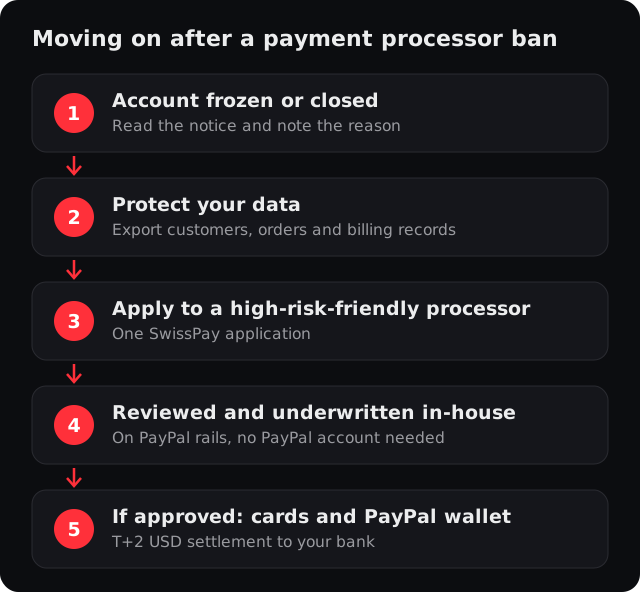
For merchants in SwissPay's supported verticals, SwissPay connects through the SwissPay Shopify plugin. SwissPay provides that Shopify plugin, plus a WooCommerce plugin, a REST API, and hosted checkout, so you connect it from your store's payment settings and keep your Shopify storefront and dashboard. Payments run on PayPal rails. SwissPay is a PayPal-managed payment facilitator operated by MintAds Inc.: it boards and underwrites merchants in-house, so you do not need your own PayPal account to take card and PayPal-wallet payments.
Card payments settle in USD to your own bank account on a T+2 schedule, with card and wallet vaulting built for subscriptions, rebills and trials. SwissPay handles chargebacks and PayPal disputes with automated evidence submission, and it is a PCI DSS Level 1 Service Provider (PCI DSS v4.0.1, AOC 2026). In plain terms, the store stays on Shopify and only the processor changes. There is no guaranteed approval, and SwissPay does not replace Shopify Payments for every merchant; it is the alternative for the stores and categories Shopify Payments turns away, or for owners who simply want a different processor. SwissPay serves US and Canadian merchants, and their customers can pay from anywhere PayPal is accepted.
Per-vertical notes: supplements, subscriptions, telehealth and more on Shopify
Each high-risk vertical behaves a little differently on Shopify. Supplements, subscriptions and telehealth are commonly listed on the storefront but declined by Shopify Payments, especially on rebill and trial models. Crypto and iGaming are frequently declined by the built-in processor. In each case the storefront can stay live while a third-party gateway handles the cards.
Nutraceuticals and supplements
You can typically list supplements on Shopify, but Shopify Payments frequently restricts them, especially on trial or subscription offers, so most supplement stores need a third-party gateway that underwrites nutra.
Health and wellness subscriptions
Recurring billing, trials and rebills are exactly the models Shopify Payments tends to decline. A subscription-ready gateway with card and wallet vaulting keeps the rebills running.
Telehealth and GLP-1 programs
Telehealth and prescription programs run through a licensed pharmacy are widely outside Shopify Payments and need a telehealth-friendly gateway.
Cryptocurrency and digital assets
Crypto and Web3 sales are usually declined by the built-in processor and need a crypto-friendly gateway.
iGaming and betting
Casino, sports betting, lottery and fantasy are generally not processed by Shopify Payments and require a dedicated iGaming acquirer.
Skincare and beauty
Trial and subscription beauty offers are often restricted on rebill models; a subscription-ready gateway underwrites them.
Selling something Shopify Payments will not process?
See how SwissPay works as a high-risk payment gateway for Shopify and across high-risk merchant accounts. Approval depends on your business; there is no guaranteed approval.
Apply for a merchant accountRelated
Frequently asked questions
Does Shopify allow high-risk businesses?
Can I sell high-risk products on Shopify?
What products can you not sell on Shopify at all?
Which categories does Shopify Payments usually decline?
How do I take payments on Shopify if Shopify Payments declines me?
Does using a third-party gateway replace Shopify Payments?
Apply for a merchant account
Tell us about your business. One application, boarded and underwritten in-house on PayPal rails, with card and PayPal-wallet processing built for subscriptions.
- Boarded and underwritten in-house, no separate PayPal account needed
- Card and PayPal-wallet vaulting for subscriptions, trials and rebills
- PCI DSS Level 1, 3-D Secure 2 where required, and chargeback and dispute handling built in